Free vs Paid HubSpot Themes: Which Should You Choose?
 Flexoraa
Free vs Paid HubSpot Themes: Which Should You Choose?
Choosing between a free and paid HubSpot theme can look like a simple pricing decision.
One option costs nothing. The other requires an investment.
But the real decision is more complicated.
The theme itself may be free, but building a website around it can still require design work, development time, customization, testing, and ongoing maintenance.
Likewise, paying for a theme doesn't automatically mean you're getting better value. A paid theme can still be the wrong choice if it doesn't match your requirements.
So the better question isn't:
"Should I spend money on a HubSpot theme?"
It's:
"Will paying for a theme save enough time, development effort, or limitations to justify the investment?"
This guide will help you answer that question.
The Short Answer
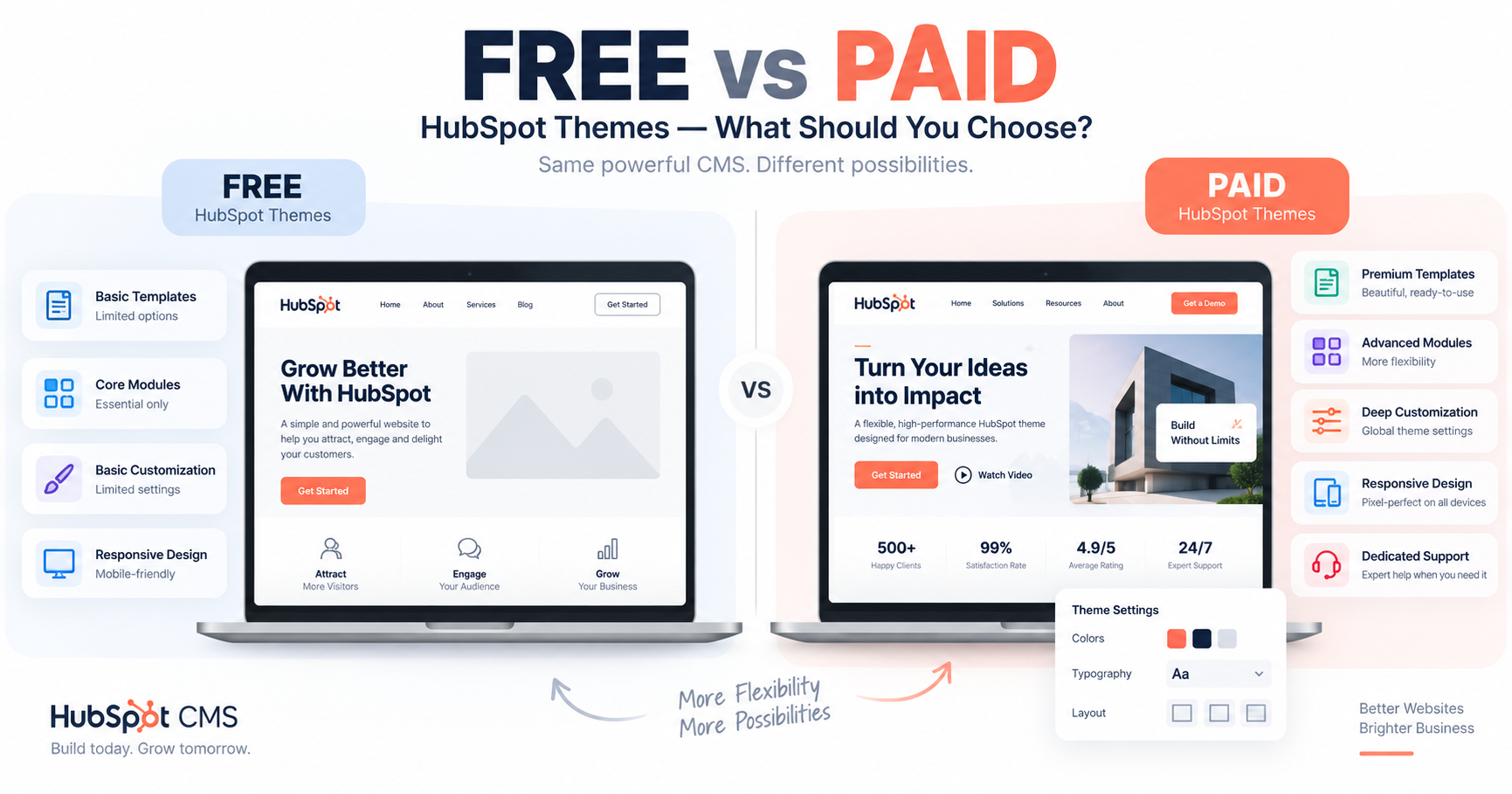
A free HubSpot theme can be a good choice when:
- Your website is relatively simple.
- Your requirements are straightforward.
- You have a limited initial budget.
- You have development resources available.
- You're comfortable working within the theme's existing structure.
- You don't need extensive theme-specific support.
- You're willing to spend additional time customizing the website.
A paid HubSpot theme may make more sense when:
- You want to launch faster.
- Your website needs many different page types.
- You want a more developed starting point.
- Your marketing team needs more freedom to create pages.
- You want to reduce repetitive development work.
- You expect your website to grow.
- The cost of development time is more significant than the theme purchase price.
Neither option is automatically better.
The right choice depends on the website you're building and the resources you have available.
What Does "Free" Actually Mean?
A free HubSpot theme means you don't pay to purchase the theme itself.
That can be a significant advantage, especially when you're starting a new website and want to keep initial costs low.
But there's an important distinction:
Free theme ≠ free website.
You may still need to spend money or time on:
- Website design
- Custom development
- Page creation
- Content implementation
- Custom modules
- Layout adjustments
- Responsive fixes
- Testing
- SEO implementation
- Ongoing maintenance
For example, imagine you find a free theme that provides a good homepage.
Your business might still need:
- Service pages
- Landing pages
- Pricing pages
- Team pages
- Case studies
- Resource pages
- Custom sections
- Additional modules
If the theme doesn't provide what you need, someone has to build it.
That someone might be you, your internal developer, or an external developer.
So the initial theme price is only one part of the total project cost.
What Does a Paid HubSpot Theme Give You?
A paid theme requires an investment, but the reason businesses pay for one is usually not simply "more features."
The real value can be the starting point.
Instead of beginning with a relatively basic foundation, a well-developed paid theme may give you a larger collection of ready-to-use building blocks.
That can reduce the amount of work required before your website starts looking and functioning the way you want.
Depending on the theme, you may get:
- More ready-made page structures
- Reusable sections
- Additional modules
- Multiple layouts
- More design controls
- More theme settings
- Documentation
- Support
- Updates
- More flexibility for marketing teams
But this is important:
Paid does not automatically mean better.
A poorly designed paid theme can provide less value than a well-built free theme.
The question is always:
What are you actually getting for the money?
The Real Difference: Your Time
This is where the free-versus-paid decision becomes more interesting.
Suppose two themes are available.
Option A — Free Theme
Theme cost:
$0
But your team needs to spend:
- 10 hours adapting layouts
- 8 hours creating missing sections
- 6 hours adjusting styling
- 5 hours fixing responsive issues
- Additional developer time for custom requirements
The theme was free.
But the implementation wasn't.
Option B — Paid Theme
Theme cost:
$X
But many of the structures you need already exist.
Your team can spend more of its time on:
- Content
- SEO
- Conversion optimization
- Lead generation
- Marketing campaigns
- Analytics
- Customer experience
The paid theme isn't necessarily cheaper.
But it may allow your team to reach the finished website faster.
And sometimes that is worth more than the theme price.
The Hidden Cost of a Free Theme
The biggest advantage of a free theme is obvious:
You don't pay for the theme.
The hidden cost is less obvious:
You may need to build more yourself.
Consider a business that needs a website with 20 different pages.
The free theme might provide a basic foundation.
But if the team needs to create many custom layouts, the development effort can increase.
For a developer, this might be perfectly acceptable.
For a marketing team waiting weeks for every new landing page, it may become frustrating.
For an agency managing multiple client websites, the additional development hours can become even more significant.
So ask:
How much development work will this free theme require before it becomes the website I actually need?
That's a much better question than simply asking whether the theme costs $0.
When a Free HubSpot Theme Makes Sense
A free theme can be the right decision.
You don't need to pay for something simply because paid options exist.
A free theme may be a good fit when your website has relatively straightforward requirements.
For example:
1. You're building a small website
If you need only:
- Home
- About
- Services
- Contact
- Blog
a free theme may provide everything you need.
2. You have an experienced developer
If your team already has strong HubSpot CMS development capabilities, extending a simpler theme may be more efficient than purchasing a more extensive theme.
3. Your design requirements are simple
If you're comfortable working within an existing design system, there may be little reason to pay for additional flexibility.
4. Your budget is extremely limited
For a new business or early-stage project, minimizing initial expenses can be important.
5. You're testing an idea
If you're validating a new business or website concept, you may not need a sophisticated theme immediately.
A free theme can help you get started without making a larger upfront investment.
When Paying for a HubSpot Theme May Be Worth It
A paid theme becomes more interesting when time and development effort matter more than the initial theme cost.
For example:
1. You need to launch quickly
If your website needs to go live soon, starting with a more developed foundation can reduce implementation time.
2. Your website has many page types
A growing business might need:
- Service pages
- Product pages
- Landing pages
- Pricing pages
- Team pages
- Case studies
- Resource pages
- Blog layouts
- Campaign pages
Building all of these from scratch can take considerable effort.
3. Your marketing team needs independence
If marketers frequently create new pages, a flexible theme can reduce their dependence on developers.
That can be especially valuable for:
- Campaign launches
- Lead-generation pages
- Product launches
- Content marketing
- A/B testing
4. You want to reduce repetitive development
Developers don't necessarily want to rebuild the same website patterns repeatedly.
A developed theme can provide reusable structures that allow developers to focus on more important custom requirements.
5. Your website is expected to grow
A website that starts with five pages may eventually have fifty.
Choosing a foundation that can accommodate that growth can reduce the need for another major rebuild later.
Free Theme + Developer vs Paid Theme
This is one of the most useful comparisons to make.
You aren't really choosing between:
Free vs $X
You may actually be choosing between:
Free theme + additional development
and
Paid theme + less initial development
Consider this example.
| Approach | Theme Cost | Development | Time to Launch |
|---|---|---|---|
| Free theme | $0 | Potentially higher | Potentially longer |
| Paid theme | Higher | Potentially lower | Potentially faster |
| Custom development | Highest | Highest | Depends on project |
These are not universal rules.
A free theme can be highly capable.
A paid theme can require significant customization.
Custom development can sometimes be the best solution.
The important thing is to compare the complete project, not just the theme price.
What About Building Everything From Scratch?
There is another option:
Don't use a theme at all. Build the website yourself.
This can make sense when the project has highly specific requirements.
Custom development gives you maximum control over:
- Architecture
- Design
- Components
- Functionality
- Integrations
- User experience
But it also requires more planning, development, testing, and maintenance.
For a highly customized website, that investment may be completely justified.
For a typical marketing website, however, building every common component from scratch may not be the most efficient use of time.
This is where a theme can provide a useful middle ground:
More flexibility than starting from a rigid template, without requiring everything to be built from zero.
The Opportunity Cost Matters Too
There's another cost that is easy to overlook:
What could your team have been doing instead?
Imagine your developer spends three weeks rebuilding common website components.
During those three weeks, they aren't working on:
- Product improvements
- Integrations
- Conversion features
- Marketing automation
- Performance improvements
- Customer requests
Likewise, if your marketing team is constantly waiting for development help, campaigns may take longer to launch.
So the question isn't only:
"How much does the theme cost?"
Consider:
"What could my team accomplish if they didn't have to build these common website components themselves?"
That is the opportunity cost of your development time.
Don't Assume Every Paid Theme Is Worth Buying
It's easy to fall into another trap.
You see a paid theme with:
- 50 modules
- 30 templates
- Hundreds of settings
- Multiple layouts
and assume it must be better.
Not necessarily.
More isn't always better.
A theme can have hundreds of options and still provide a frustrating editing experience.
Before paying for a theme, ask:
- Does it actually solve my problems?
- Will my team use the features?
- Does it reduce development work?
- Is it maintained?
- Is documentation available?
- Is support available?
- Can the theme grow with the website?
- Does the price make sense for this project?
A theme should earn its price through useful value, not through a long feature list.
A Simple Cost-Benefit Calculation
You can make the decision more objective.
Start with the approximate value of your development time.
For example, suppose a developer costs your business $20 per hour.
If a free theme requires an additional 30 hours of development:
30 × $20 = $600
The free theme didn't necessarily cost $600
But the additional development effort has an economic value of $600
Now suppose a paid theme costs $200 and reduces that work by 20 hours.
The comparison becomes very different.
This doesn't mean the paid theme automatically wins.
You still need to consider:
- Quality
- Flexibility
- Maintenance
- Support
- Actual time saved
- Long-term usefulness
But calculating development effort can make the decision much clearer.
What If I'm a Freelancer or Agency?
The calculation can be different for agencies and freelancers.
If you're building websites repeatedly, reusable foundations can have greater value.
A theme can potentially help you:
- Start projects faster
- Reuse common structures
- Reduce repetitive development
- Deliver websites sooner
- Focus on client-specific functionality
- Standardize parts of your workflow
However, you should also consider whether the theme is flexible enough for different clients.
A theme that works perfectly for one business may become restrictive when you need to adapt it to another.
For agencies, flexibility and reusability can therefore be more important than the initial theme price.
What If I'm a Marketer With No Developer?
This is another situation where a paid theme can potentially provide more value.
If you depend on a developer every time you need to:
- Create a landing page
- Change a layout
- Add a section
- Update a page structure
- Launch a campaign
your real cost isn't just development money.
It's also waiting time.
A theme that gives marketers greater control can help reduce that dependency.
But again, don't assume a paid theme provides this automatically.
Test the actual editing experience before buying.
What If I'm a Developer?
Your priorities may be different.
If you're comfortable building custom HubSpot CMS components, you may prefer a simpler theme that gives you a clean foundation.
You might care more about:
- Code quality
- Extensibility
- Architecture
- Performance
- Reusability
- Maintainability
- Custom development flexibility
In that situation, paying for a feature-heavy theme may not necessarily provide additional value.
Your own development capability changes the equation.
Free vs Paid: A Better Decision Framework
Instead of asking whether free or paid is better, start with these questions.
Question 1: How complicated is the website?
Simple website
→ A free theme may be enough.
Complex website
→ Compare free, paid, and custom options carefully.
Question 2: How much development capacity do you have?
Strong internal development team
→ A simpler theme may be sufficient.
Limited development resources
→ A more developed theme may save significant time.
Question 3: How quickly do you need to launch?
No major deadline
→ You may have time to customize a free theme.
Tight deadline
→ A more developed starting point may be valuable.
Question 4: How often will marketers change the website?
Rarely
→ Developer-led customization may be fine.
Frequently
→ Prioritize a theme that gives marketers greater control.
Question 5: How much will the website grow?
Small, stable website
→ A simple theme may be enough.
Growing content and marketing website
→ Consider the long-term flexibility of the theme.
Question 6: What is your actual development cost?
If your team can customize a free theme efficiently, paying for a theme may not provide much additional value.
If every customization requires significant development time, a paid theme may make more financial sense.
So, Is a Paid HubSpot Theme Worth It?
Sometimes.
But not simply because it's paid.
A paid HubSpot theme is worth considering when the value it provides is greater than the combination of:
Theme cost + remaining development effort + maintenance cost.
The value might come from:
- Faster implementation
- Less repetitive development
- More ready-to-use structures
- Greater marketing independence
- Easier website expansion
- Documentation
- Support
- A stronger starting point
If a free theme already meets your requirements, there may be no reason to pay.
If a paid theme saves weeks of development and gives your marketing team the flexibility they need, the investment may be easy to justify.
Where Does Flexoraa Fit?
Flexoraa is one example of a paid HubSpot CMS theme designed to provide a broader starting point for businesses building and managing their websites.
It currently includes:
- 42 HubSpot CMS modules
- 15 website page templates
- 31 reusable sections
- Multiple header and footer layouts
- Mega menu support
- 4 blog post layouts
- Responsive controls
- Extensive theme settings
The purpose isn't simply to provide a large feature list.
The idea is to give businesses and teams a developed foundation they can customize instead of starting every common website requirement from scratch.
Flexoraa is currently offered at $199 as a one-time purchase per HubSpot portal.
But the right way to evaluate it isn't to ask whether $199 is cheaper than $0.
Instead, ask:
Would the included foundation save enough development time or provide enough flexibility to justify the investment for my website?
If yes, it may be worth considering.
If your website is extremely simple and a free theme already provides everything you need, a free theme may be the better choice.
Explore the Flexoraa demo and compare it with your actual website requirements.
Free or Paid? Use This Final Checklist
Before making your decision, answer these questions:
| Question | Your Answer |
|---|---|
| How many pages will the website need? | |
| How many different page types? | |
| How much customization is required? | |
| Who will maintain the website? | |
| Do marketers need to create pages themselves? | |
| How much developer time is available? | |
| How quickly does the website need to launch? | |
| How much will the website grow? | |
| Does a free theme already meet the requirements? | |
| What additional development would a free theme require? | |
| What does the paid theme actually save or provide? | |
| Is the investment justified by the expected time/value savings? |
Once you answer these questions, the decision becomes much easier.
Frequently Asked Questions
Are free HubSpot themes good?
Yes. A free theme can be a perfectly good choice for the right website.
The important question is whether its capabilities match your requirements.
Are paid HubSpot themes worth the money?
They can be.
A paid theme may be worthwhile when it saves development time, provides a more useful starting point, gives marketers more control, or supports a more complex website.
But you should evaluate the actual theme rather than assuming paid automatically means better.
Is a free HubSpot theme really free?
The theme itself may have no purchase cost, but building and customizing the website can still require developer time and other resources.
Consider the total implementation cost, not only the theme price.
Should a small business buy a paid HubSpot theme?
Not necessarily.
If the business needs a simple website and a free theme already meets those requirements, a paid theme may not provide enough additional value.
If the business needs more flexibility or wants to reduce development effort, a paid theme may be worth considering.
Is a paid theme better than building a custom HubSpot website?
Not always.
A paid theme can be a useful middle ground between a basic starting point and fully custom development.
For highly specialized requirements, custom development may still be the better option.
Should I choose a free theme if I have a developer?
Possibly.
An experienced developer may be comfortable extending a simpler theme and building missing functionality.
In that situation, the value of paying for a theme depends on how much development time the paid theme would actually save.
What is the biggest mistake when comparing free and paid themes?
Looking only at the purchase price.
The better comparison is:
Theme cost + development effort + time + maintenance + long-term value.
A $0 theme isn't necessarily the cheapest solution, and a paid theme isn't necessarily the most expensive.
Conclusion
There is no universal winner in the free-versus-paid HubSpot theme debate.
A free theme can be an excellent choice when your requirements are simple, your budget is limited, or you have the development resources to customize the website yourself.
A paid theme can make more sense when you value a developed starting point, faster implementation, greater flexibility, or reduced development effort.
The important thing is to stop thinking about the decision as:
Free vs paid
and start thinking about it as:
Which approach gives me the best overall value for the website I need to build?
If a free theme gives you everything you need, use it.
If a paid theme can save meaningful time and help your team build and manage the website more effectively, consider paying for it.
Choose the solution that fits your project—not simply the one with the lowest price.